Section 53 of the Code on Social Security, 2020 — Payment of Gratuity: Eligibility, Amount and Forfeiture
Five years' service (none for death, disablement or the end of a fixed term), fifteen days' wages a year on a 26-day month, a notified cap, and when gratuity can be forfeited. (Section 53, Code on Social Security, 2020.) In force since 21 November 2025 · Replaced section 4 of the Payment of Gratuity Act, 1972 · Text checked against India Code on 25 October 2026.
Quick Statutory Answer
Under Section 53 of the Code on Social Security, 2020, in force from 21 November 2025, gratuity is payable on termination after five years of continuous service: on superannuation, retirement, resignation, death, disablement or the end of a fixed-term contract. The five years are not needed on death, disablement or the expiry of a fixed term, and are three years for a working journalist. The amount is fifteen days' wages for each completed year (a part-year over six months counts), on the last drawn wages divided by 26 for a monthly-rated employee, up to the notified cap of ₹20 lakh. It can be forfeited to the extent of damage caused, or wholly or partly for violence or an offence of moral turpitude in the course of employment.
Enter your own figures in the calculator on this page: Gratuity calculator, under Code on Social Security, 2020, s.53 (formerly Payment of Gratuity Act, 1972, s.4).
Gratuity calculator, with the method and worked examples
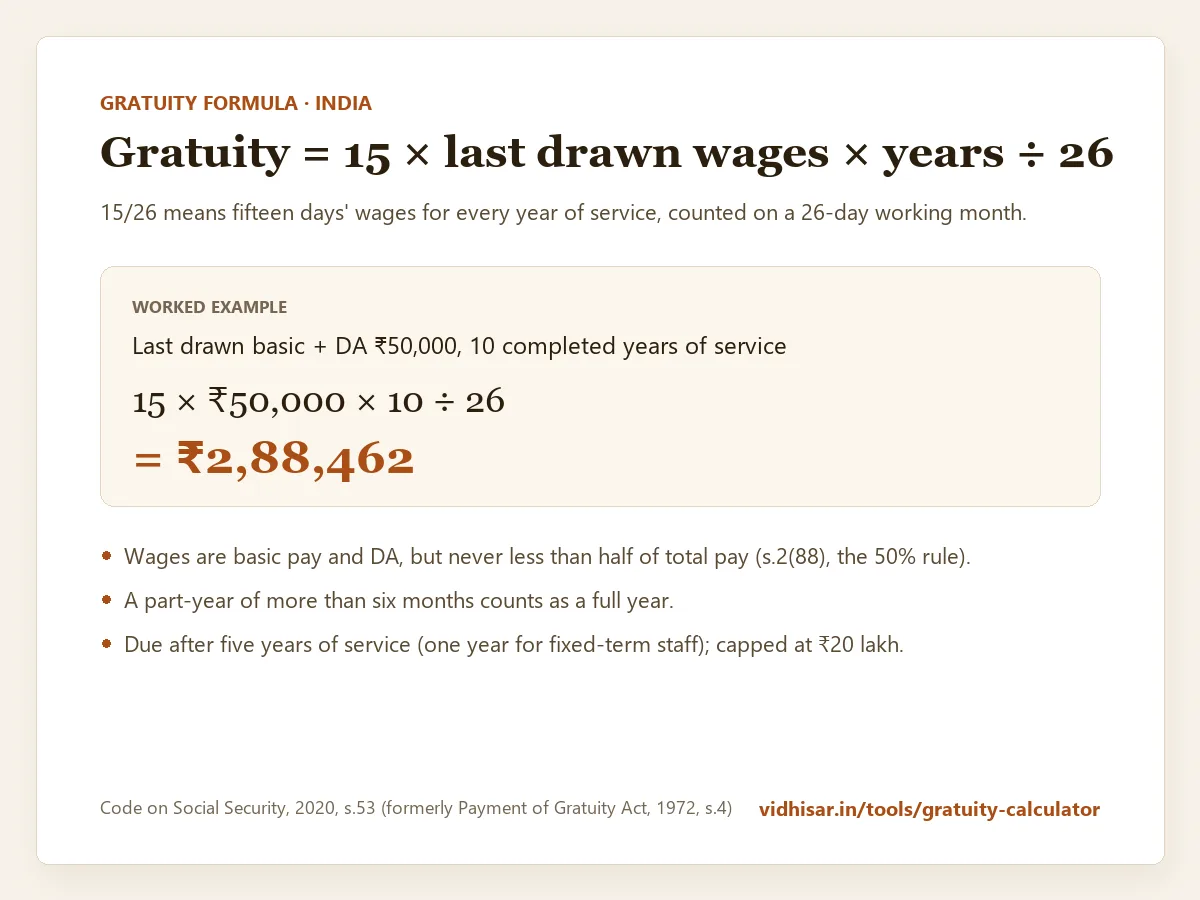
Gratuity formula in India: 15 × last drawn wages × years of service ÷ 26, worked for ₹50,000 and 10 years = ₹2,88,462
The text of Section 53
53. Payment of gratuity.— (1) Gratuity shall be payable to an employee on the termination of his employment after he has rendered continuous service for not less than five years,— (a) on his superannuation; or (b) on his retirement or resignation; or (c) on his death or disablement due to accident or disease; or (d) on termination of his contract period under fixed term employment; or (e) on happening of any such event as may be notified by the Central Government: Provided that in case of working journalist as defined in clause (f) of section 2 of the Working Journalists and Other Newspaper Employees (Condition of Service) and Miscellaneous Provisions Act, 1955 (45 of 1955), the expression "five years" occurring in this sub-section shall be deemed to be three years: Provided further that the completion of continuous service of five years shall not be necessary where the termination of the employment of any employee is due to death or disablement or expiration of fixed term employment or happening of any such event as may be notified by the Central Government: Provided also that in the case of death of the employee, gratuity payable to him shall be paid to his nominee or, if no nomination has been made, to his heirs, and where any such nominees or heirs is a minor, the share of such minor, shall be deposited with the competent authority as may be notified by the appropriate Government who shall invest the same for the benefit of such minor in such bank or other financial institution, as may be prescribed by the appropriate Government, until such minor attains majority. (2) For every completed year of service or part thereof in excess of six months, the employer shall pay gratuity to an employee at the rate of fifteen days' wages or such number of days as may be notified by the Central Government, based on the rate of wages last drawn by the employee concerned: Provided that in the case of a piece-rated employee, daily wages shall be computed on the average of the total wages received by him for a period of three months immediately preceding the termination of his employment, and, for this purpose, the wages paid for any overtime work shall not be taken into account: Provided further that in the case of an employee who is employed in a seasonal establishment and who is not so employed throughout the year, the employer shall pay the gratuity at the rate of seven days' wages for each season: Provided also that in the case of an employee employed on fixed term employment or a deceased employee, the employer shall pay gratuity on pro rata basis. (3) The amount of gratuity payable to an employee shall not exceed such amount as may be notified by the Central Government. (4) For the purpose of computing the gratuity payable to an employee who is employed, after his disablement, on reduced wages, his wages for the period preceding his disablement shall be taken to be the wages received by him during that period, and his wages for the period subsequent to his disablement shall be taken to be the wages as so reduced. (5) Nothing in this section shall affect the right of an employee to receive better terms of gratuity under any award or agreement or contract with the employer. (6) Notwithstanding anything contained in sub-section (1),— (a) the gratuity of an employee, whose services have been terminated for any act, wilful omission or negligence causing any damage or loss to, or destruction of, property belonging to the employer, shall be forfeited to the extent of the damage or loss so caused; (b) the gratuity payable to an employee may be wholly or partially forfeited— (i) if the services of such employee have been terminated for his riotous or disorderly conduct or any other act of violence on his part, or (ii) if the services of such employee have been terminated for any act which constitutes an offence involving moral turpitude, provided such offence is committed by him in the course of his employment. Explanation 1.— For the purposes of this Chapter, employee does not include any such person who holds a post under the Central Government or a State Government and is governed by any other Act or by any rules providing for payment of gratuity. Explanation 2.— For the purposes of this section, disablement means such disablement as incapacitates an employee for the work which he was capable of performing before the accident or disease, resulting in such disablement. Explanation 3.— For the purposes of this section, it is clarified that in the case of a monthly rated employee, the fifteen days' wages shall be calculated by dividing the monthly rate of wages last drawn by him by twenty-six and multiplying the quotient by fifteen.
What the section does
Gratuity is payable when employment ends after at least five years of continuous service: on superannuation, retirement or resignation, death or disablement, the end of a fixed-term contract, or a notified event.
The five years are not required where employment ends by death, disablement or the expiry of a fixed term; for a working journalist the period is three years. A fixed-term or deceased employee is paid pro rata, and on death the gratuity goes to the nominee or the heirs.
The amount is fifteen days' wages for each completed year of service, a part-year over six months counting as a year, on the wages last drawn; for a monthly-rated employee the month is taken as twenty-six days. Piece-rated and seasonal employees have their own rules, and the total cannot exceed the notified cap of ₹20 lakh.
Gratuity is forfeited to the extent of damage an employee caused to the employer's property, and may be forfeited wholly or partly if the employee was terminated for riotous or disorderly conduct, violence, or an offence involving moral turpitude committed in the course of employment.
Section 53 gratuity: who, how much, and when it is lost
Section 53 gratuity: who, how much, and when it is lost
Point
Rule
Provision
Qualifying service
Five years of continuous service
s.53(1)
No minimum service
Death, disablement, end of a fixed term, or a notified event
Second proviso to s.53(1)
Working journalists
Three years instead of five
First proviso to s.53(1)
Amount
Fifteen days' wages per completed year; a part-year over six months counts
s.53(2)
Monthly-rated employee
Monthly wage ÷ 26 × 15 per year
Explanation 3
Piece-rated employee
Daily wage from the last three months' average, without overtime
First proviso to s.53(2)
Seasonal establishment
Seven days' wages for each season
Second proviso to s.53(2)
Fixed-term or deceased employee
Paid pro rata
Third proviso to s.53(2)
Cap
As notified by the Central Government: ₹20,00,000
s.53(3)
Better terms
An award, agreement or contract paying more prevails
s.53(5)
Forfeiture
To the extent of damage caused; wholly or partly for violence, or a moral-turpitude offence at work
s.53(6)
Formula
(15 × last wages × years) ÷ 26. For a monthly-rated employee, under Explanation 3; capped at the notified ₹20,00,000, with better contractual terms preserved by s.53(5).
Where people go wrong
Forfeiting gratuity for ordinary misconduct. Section 53(6) allows forfeiture only for damage to property (to that extent), or wholly or partly for violence or a moral-turpitude offence in the course of employment.
Dividing by 30. Explanation 3 divides the monthly wage by twenty-six, which gives a higher figure.
Paying fixed-term staff nothing because they left before five years. The five years are not required when a fixed term expires, and the payment is pro rata.
Paying a minor heir's share directly. It is deposited with the notified competent authority until the minor comes of age.
Common questions
What is section 53 of the Code on Social Security?
The provision that governs gratuity since 21 November 2025, replacing section 4 of the Payment of Gratuity Act, 1972. It sets when gratuity is payable, how it is calculated, the notified cap, and when it can be forfeited.
What is the minimum service for gratuity under the new labour code?
Five years of continuous service, as before. The condition does not apply on death, disablement or the expiry of a fixed-term contract, and it is three years for a working journalist. The Labour Ministry puts the minimum for fixed-term employees at one year, paid pro rata.
How is gratuity calculated under section 53?
Fifteen days' wages for every completed year of service, counting a part-year over six months as a full year, on the wages last drawn. For a monthly-rated employee, the monthly wage is divided by 26 and multiplied by 15 for each year, under Explanation 3. The total is capped at the notified ₹20 lakh.
When can an employer forfeit gratuity?
Under section 53(6): to the extent of damage or loss the employee caused to the employer's property, where that was the reason for termination; and wholly or partly where the employee was terminated for riotous or disorderly conduct, violence, or an offence involving moral turpitude committed in the course of employment.
Can an employer pay more gratuity than section 53 requires?
Yes. Section 53(5) preserves any better terms under an award, agreement or contract, and the cap applies only to the statutory amount.
Act on this
Gratuity calculator (Code on Social Security)
Section 4 of the Payment of Gratuity Act — what changed
Maintains the law explainers, calculators, templates and blog posts on vidhisar.in: checks them against the statute text and updates them when the law changes. Errors and changes in the law can be reported to legal@vidhisar.in.
The section in its own words, with a plain-English explanation of what it requires. Not legal advice: take advice on anything turning on your own facts.