Commercial contracts · Template

Freelance and contractor agreement template for India

The clause that matters most in a freelance contract is the one most freelance contracts leave out. Under Indian copyright law an independent contractor is not an employee, and paying for work does not by itself transfer ownership of it. Without a written assignment, you commissioned the work and they own it.

Quick Statutory Answer

Do I own the work if I paid a freelancer for it? Not automatically. Section 17 of the Copyright Act, 1957 makes the employer the first owner of work made in the course of employment, but an independent contractor works under a contract for service, not a contract of service. Ownership passes only by an assignment that, under s. 19, is in writing and signed by the assignor.

Draft this document See all 30 templates

Freelance / Contractor Agreement format

The full text of this document as VidhiSar drafts it, with every blank shown in square brackets. Copy it or download it as a Word file and fill it in yourself — or answer a few questions and VidhiSar fills it in and prints a formatted PDF. Clauses that apply only in some cases are left out here; the drafting flow adds them when your answers call for them.

FREELANCE SERVICE AGREEMENT

This Freelance Service Agreement ("Agreement") is entered into on [Agreement Start Date] between:

1. [Client Name / Company Name], located at [Client Address] (hereinafter "Client") 2. [Freelancer / Contractor Name], located at [Freelancer Address] (hereinafter "Service Provider")

1. SCOPE OF WORK

The Service Provider agrees to provide the following services ("Services"): [Description of Services / Deliverables]. These services shall be delivered as per timelines mutually agreed upon and documented in separate project briefs or purchase orders.

2. PAYMENT TERMS

The Client agrees to pay the Service Provider Rs. [Total Project Fee] for the Services. Payment shall be made via [Payment Mode] within [Payment Days After Delivery] days of delivery of each milestone / final deliverable. Late payments shall attract interest at 18% per annum.

3. INTELLECTUAL PROPERTY

Upon full payment, all intellectual property (including but not limited to designs, code, content, and strategies) created exclusively for this project shall vest in the Client. All pre-existing IP of the Service Provider remains the Service Provider's property.

4. CONFIDENTIALITY

Both parties agree to maintain strict confidentiality over all proprietary information, business data, and trade secrets shared during the engagement. This obligation shall survive termination of this Agreement for [Confidentiality Duration] years.

5. INDEPENDENT CONTRACTOR

The Service Provider is an independent contractor and not an employee, partner, or agent of the Client. No employee benefits, PF, ESI, or statutory deductions apply to this engagement.

6. TERM AND TERMINATION

This Agreement commences on [Agreement Start Date] and continues until project completion unless terminated earlier by either party with [Notice Period for Termination] days' written notice. Upon termination, work completed and accepted shall be paid for on a pro-rata basis.

7. LIMITATION OF LIABILITY

The total liability of the Service Provider under this Agreement shall not exceed the total fees paid for the project. Neither party shall be liable for indirect, consequential, or punitive damages.

8. DISPUTE RESOLUTION

Any disputes shall first be resolved through good-faith negotiation. If unresolved within 30 days, disputes shall be submitted to arbitration under the Arbitration and Conciliation Act, 1996, at [City for Dispute Resolution].

9. GOVERNING LAW

This Agreement is governed by the laws of the Republic of India.

SIGNATURES

IN WITNESS WHEREOF, the parties have executed this Agreement as of the date first written above.
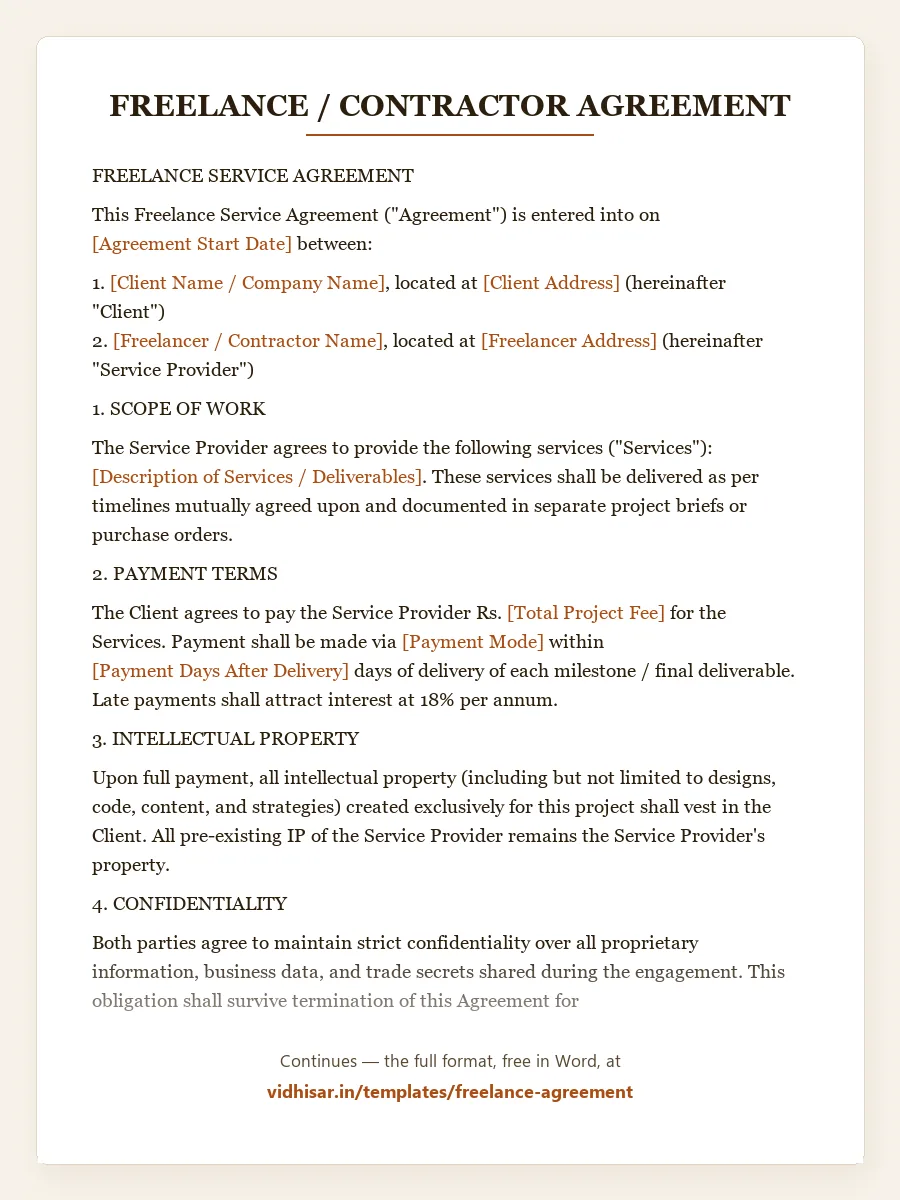
Freelance / Contractor Agreement format (India): page one of the document, with each blank to fill in shown in brackets

Further reading

What the law behind this document actually requires.

  • TDS on Contractor & Freelancer Payments: Section 393 (formerly 194C & 194J) — Since 1 April 2026, TDS on contractors and professionals is section 393 of the Income-tax Act, 2025. The rates (1%, 2%, 10%), the thresholds, and what failing to deduct costs.

Related statutory compliance tools & calculators

  • GST Late Fee Calculator 2026 — Calculate CGST/SGST Section 47 late fees and Section 50 interest
  • TDS Late Payment Interest Calculator — Calculate section 398 interest and section 427 late fees (formerly 201(1A) and 234E)

What this document must contain (Clause-by-Clause Matrix)

Freelance / Contractor Agreement — Mandatory Clause Matrix & Statutory Protection (2026)
Essential Clause Legal Purpose & Protection Governing Law / Benchmark
A written assignment of intellectual property This is the clause the document exists for. Under the Copyright Act, 1957, an assignment must be in writing and signed. Absent it, the contractor retains ownership of what you paid for. Copyright Act, 1957 — s. 17
Scope of work and deliverables What is being produced, in what format, to what standard, and what is expressly out of scope. Revisions should be bounded by number or by time. Copyright Act, 1957 — s. 19
Fee, payment schedule and payment window Milestones and a stated number of days after delivery. If the contractor is a registered micro enterprise, the MSMED payment ceiling is engaged. MSMED Act, 2006 — ss. 15 & 16
Independent contractor status State plainly that this is not employment and carries no employment benefits. The substance of the relationship still governs, but the record should reflect the intent. Copyright Act, 1957 — s. 17
Confidentiality with a stated duration Either a full clause here or a separate NDA — but not silence, where the contractor is seeing anything sensitive. Copyright Act, 1957 — s. 19
Termination and notice How either side exits, what is owed for work in progress, and what happens to partially completed deliverables. MSMED Act, 2006 — ss. 15 & 16
Named jurisdiction One Indian city whose courts decide, agreed while everyone is still friendly. Copyright Act, 1957 — s. 17
  • A written assignment of intellectual property — This is the clause the document exists for. Under the Copyright Act, 1957, an assignment must be in writing and signed. Absent it, the contractor retains ownership of what you paid for.
  • Scope of work and deliverables — What is being produced, in what format, to what standard, and what is expressly out of scope. Revisions should be bounded by number or by time.
  • Fee, payment schedule and payment window — Milestones and a stated number of days after delivery. If the contractor is a registered micro enterprise, the MSMED payment ceiling is engaged.
  • Independent contractor status — State plainly that this is not employment and carries no employment benefits. The substance of the relationship still governs, but the record should reflect the intent.
  • Confidentiality with a stated duration — Either a full clause here or a separate NDA — but not silence, where the contractor is seeing anything sensitive.
  • Termination and notice — How either side exits, what is owed for work in progress, and what happens to partially completed deliverables.
  • Named jurisdiction — One Indian city whose courts decide, agreed while everyone is still friendly.

When you need this

  • Before engaging a designer, developer, writer or consultant on a project basis
  • When the deliverable is something you need to own outright — code, brand assets, written material
  • Where the engagement is ongoing enough that scope creep is a real risk
  • When you are the freelancer and want payment timelines documented
  • Where the contractor will see confidential information or personal data

The law that governs it

  • Copyright Act, 1957 — s. 17 — In the case of a work made in the course of employment under a contract of service, the employer is the first owner in the absence of agreement to the contrary. An independent contractor works under a contract for service, so that rule does not apply — which is why the assignment must be express.
  • Copyright Act, 1957 — s. 19 — An assignment of copyright must be in writing and signed by the assignor. An oral understanding, or an invoice marked 'full rights', does not meet the requirement.
  • MSMED Act, 2006 — ss. 15 & 16 — Where the contractor is a registered micro or small enterprise, the statutory payment ceiling and the compound interest liability apply to your payment terms as well.

Common mistakes

  • Assuming payment transfers ownership, and discovering otherwise during a fundraise or an acquisition
  • Taking an IP assignment that is not in writing and signed, so it does not meet s. 19
  • Leaving revisions unbounded, which turns a fixed fee into an open-ended commitment
  • Describing a contractor in terms that read as employment, which invites the relationship to be recharacterised
  • No confidentiality term at all, where the contractor is working inside your systems

Frequently asked questions

Do I own the work if I paid a freelancer for it?

Not automatically. Section 17 of the Copyright Act, 1957 makes the employer the first owner of work made in the course of employment, but an independent contractor works under a contract for service, not a contract of service. Ownership passes only by an assignment that, under s. 19, is in writing and signed by the assignor.

Is a freelancer an employee under Indian law?

Not if the relationship is genuinely one of an independent contractor — but the label in the contract is not decisive. Courts look at the substance: control over how the work is done, integration into the organisation, exclusivity and economic dependence. A contract that says 'contractor' while the relationship operates as employment can be recharacterised.

Does the MSME payment rule apply to freelancers?

It applies where the freelancer is registered as a micro or small enterprise under Udyam. In that case the payment ceiling in s. 15 of the MSMED Act, 2006 and the compound interest liability in s. 16 apply to your payment terms exactly as they would to any other supplier.

Should the agreement be stamped?

Where the instrument is chargeable with duty it should be stamped before execution, and rates are State-specific. Under s. 35 of the Indian Stamp Act, 1899 an unstamped chargeable instrument cannot be admitted in evidence, which is a poor position to discover during a dispute over ownership.

Maintained by the VidhiSar Legal Team

Maintains the law explainers, calculators, templates and blog posts on vidhisar.in: checks them against the statute text and updates them when the law changes. Errors and changes in the law can be reported to legal@vidhisar.in.